Antenna Gain vs. Takeoff Angle: Why Bigger Isn't Always Better in NEPA's Hills
Ask five people which antenna to buy for a Meshtastic node and four of them will point at whichever one has the highest gain number printed on it. More dBi, more range. It's intuitive, it's on the packaging in big letters, and for a lot of RF use cases it's even correct.
It is also the single most common way to make a NEPAMesh node perform worse than the rubber duck it replaced.
The homebrew antenna guide covers how to build the things and what gain actually means. This post covers something that guide only touched on: gain has a shape, and in ridge-and-valley terrain, the shape matters more than the number.
Gain Doesn't Add Signal. It Redistributes It.
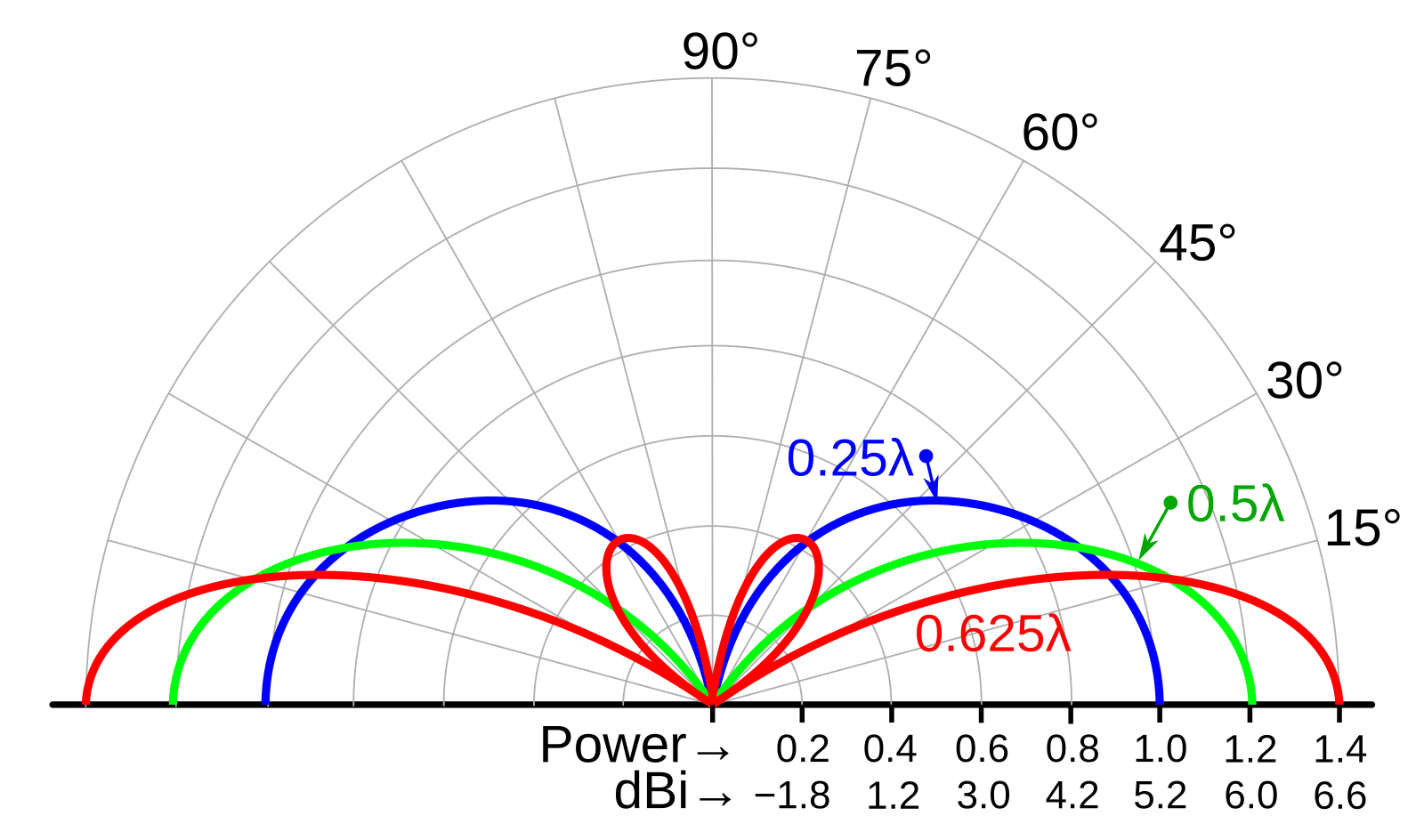
An antenna can't manufacture power out of nothing. Every dBi of gain in one direction is signal taken from somewhere else in the radiation pattern. A unity-gain antenna radiates roughly like a donut around the antenna: strong to the sides, weak straight up and down. A high-gain collinear takes that same donut and squashes it flatter, pushing more energy toward the horizon and less toward anything above or below it.
That flattening is described by takeoff angle: the vertical angle above the horizon where an antenna radiates most of its energy. Low-gain antennas have a tall, round pattern and a high takeoff angle. High-gain collinears have a flat, wide pattern and a low takeoff angle, often just a few degrees above horizontal.
On flat ground, a low takeoff angle is exactly what you want. Nearly everything you're trying to reach sits near the horizon anyway, so squeezing the pattern flat concentrates your signal where the other stations actually are. This is why cellular carriers and flat-terrain repeater sites run high-gain collinears almost exclusively.
NEPA is not flat ground.
The Valley-Floor Problem
Picture a home node sitting in a house in the Wyoming Valley. The nearest useful thing it can hear isn't another house three streets over on the same flat plane, it's a repeater on Penobscot Mountain or Larksville Mountain, sitting six or seven hundred feet above the valley floor and less than two miles away in a straight line.
Draw that line and it isn't anywhere near horizontal. Depending on distance and elevation difference, the angle from the valley node up to the ridge repeater can easily run 8 to 15 degrees above horizontal, sometimes more.
Put a 9 dBi collinear on that valley node and its takeoff angle might be sitting at 3 to 5 degrees. The ridge repeater is above the antenna's strongest lobe, potentially in or near a null in the pattern. The node ends up quieter to its single most useful neighbor than it would have been with a cheap 2.15 dBi dipole, which radiates a broad enough pattern to still put usable signal at 12 degrees of elevation.
This is the same effect ham radio operators have dealt with for decades with HT users complaining a "better" antenna made them worse at hitting a nearby repeater on a hill. The physics doesn't care that it's LoRa instead of FM.
The Ridge-Top Case Is the Opposite
Flip the geometry and the advice flips with it. A router node mounted on a ridge, looking out across a valley at a dozen home nodes on the valley floor and at other ridges miles away, is looking at targets that are, from its perspective, close to level or even below it. That's exactly the geometry a flattened, high-gain pattern was built for.
A 6 to 9 dBi collinear on a ridge-top router concentrates energy toward the horizon, where the distant, roughly-level targets actually sit, instead of wasting it on empty sky above and rock below. This is the one deployment type in NEPA where chasing gain is close to a free upgrade.
The rule isn't "high gain is bad." It's "high gain is a bet that your targets are near your horizon." On a ridge, that bet usually pays off. In a valley, it usually doesn't.
A Rule of Thumb for NEPA Deployments
| Situation | Likely target geometry | Antenna choice |
|---|---|---|
| Home node, valley floor, nearest useful node is a nearby ridge | High elevation angle | 2–3 dBi omni (dipole, ground plane, or Slim Jim) |
| Ridge-top router covering a valley and distant ridges | Low, near-horizon angle | 6–9 dBi collinear |
| Mobile node (vehicle, backpack) | Constantly changing angle | 2–3 dBi omni, never a high-gain fixed-pattern antenna |
| Node in a mixed neighborhood, no dominant nearby high target | Unknown / mixed | Start low gain, upgrade only once you understand your actual link geometry |
When in doubt, start low. A 2 dBi antenna that's wrong for your situation still works reasonably in most directions. A 9 dBi antenna that's wrong for your situation can leave you nearly deaf to the one node you most need to hear, while looking perfectly fine on paper.
What a NanoVNA Won't Tell You
The NanoVNA antenna testing guide covers measuring SWR and resonance, and both matter. But SWR tells you whether your antenna is efficiently accepting power from the radio. It says nothing about which direction that power goes once it leaves the antenna. Two antennas can show identical 1.2:1 SWR at 915 MHz and have completely different radiation patterns. Gain and takeoff angle come from the antenna's physical geometry (length, number of elements, phasing), not from anything a VNA sweep can measure.
If you want to know your antenna's actual pattern, the honest answer is you mostly can't, not without an anechoic chamber or a lot of careful field measurement. What you can do is understand the general shape that comes with the antenna type you bought, and pick the type that matches your geometry instead of just the type with the biggest number on the listing.
Before You Buy
Check the shadow map and look at what's actually near your planned node, and at what angle. If a ridge repeater sits close and high, that geometry wants a low-gain omni. If your node itself is the ridge repeater, looking out over a valley, that geometry wants gain.
The node placement guide has more on reading the terrain before you climb anything. This post is the piece that explains why the antenna you pick once you get up there matters as much as the elevation itself.
NEPAMesh is a community Meshtastic network covering Northeastern Pennsylvania's Wyoming Valley. Live map at map.nepamesh.com. Questions in the Discord.
Meshtastic is a registered trademark of Meshtastic LLC. No warranty is provided. Use at your own risk. This post is not endorsed by or affiliated with Meshtastic LLC.