When the Cell Towers Go Down: Using NEPAMesh for Emergency and Off-Grid Communication
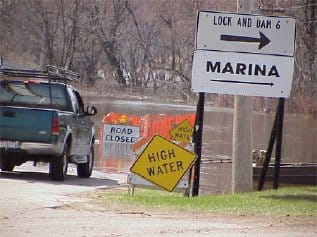
In September 2021, the remnants of Hurricane Ida came through Luzerne County. Roads were underwater. Residents were stranded. People died. And for a stretch of hours that mattered enormously to the people living through it, cellular service in parts of the region was unreliable or gone.
That wasn't unusual. Storms and cell service have an adversarial relationship in NEPA, and NEPA gets its share of storms. Ice in the winters. Flooding along the Susquehanna and its tributaries in the spring. The occasional remnant tropical system in late summer that turns mountain streams into hazards. Power outages here aren't rare inconveniences, they're a regular feature of life, sometimes lasting days in rural Sullivan, Wyoming, and Bradford counties where crews have to reach substations and lines on roads that are themselves out.
This post is about what Meshtastic actually provides in those scenarios, what it doesn't, and the one thing most people get backwards: preparation has to happen before the emergency, not during it.
Why Cell Towers Fail
Cell towers look like durable infrastructure. They mostly are. But they have dependencies that break under the same conditions that cause emergencies in the first place.
Commercial power. Cell towers run on grid power. Most have battery backup that lasts four to eight hours and a subset have generators. When a storm knocks out power for 72 hours, which happens in NEPA, towers without generator fuel or without generators at all go dark. The coverage map on your carrier's website shows you normal conditions, not storm conditions.
Backhaul. A cell tower is a radio interface. Behind it, your call or data travels over fiber or microwave links to the carrier's core network. If that backhaul path is cut, a fiber line underwater, a microwave link with a failed antenna, the tower may be running but can't carry traffic anywhere. You'll see full bars and get nothing through.
Congestion. When something significant happens in an area, everyone picks up their phone at once. The tower's capacity is designed for normal utilization, not for every subscriber simultaneously trying to call family to say they're okay. Even a tower that's fully operational will drop most calls and data requests under that load. If you've ever tried to make a call on New Year's Eve or right after a major local event, you've felt a small version of this.
None of this is a failure of the carriers. It's engineering reality. The system is built for the 99th percentile of normal demand, not for simultaneous peak demand during a regional emergency. That gap is exactly where a mesh radio network fits.
What Meshtastic Provides
Meshtastic nodes are radios. They don't need cell towers, internet connectivity, or commercial power to operate. A node running on a battery pack keeps working when the grid is down. A solar node keeps working as long as there's daylight. The mesh they form between each other, hopping messages from node to node across the network, keeps working as long as enough nodes stay online to bridge the coverage area.
In practical terms, during a grid-down event where NEPAMesh infrastructure nodes at elevation are solar-powered, the backbone of the network stays up. Home nodes that lose power go offline, but the mesh routes around them. The same property that makes mesh radio resilient in normal conditions, no single point of failure, makes it resilient under degraded conditions too.
What you can do on Meshtastic during an emergency:
Text messaging. Direct messages to specific nodes (if you know their name or ID) or broadcasts to everyone in the mesh. "Power is out, everyone okay?" is a real and useful thing to send. "Route 6 is flooded at the bridge, avoid" is a real and useful thing to receive. Text messages are small, a few dozen bytes, and route reliably across the mesh even when traffic is heavy.
Position sharing. Every node with a GPS fix shares its location on the mesh. If family members each have a node, you can see where they are without exchanging a single message. During a flood evacuation, knowing that your parents' node is showing a position two miles from where they should be is information you can act on.
Welfare checks. A node that's online is a node that's powered and within range of the mesh. A node that's gone offline after a storm is worth checking on. This is crude but real: "I can see your node is up, you're okay" is a legitimate emergency communication mode.
Coordination without a coordinator. The mesh doesn't need anyone to manage it during the emergency. There's no server to call, no account to log into, no service to be down. Anyone with a node on LONG_FAST within range of the NEPAMesh network can communicate. The decentralization isn't a limitation, it's the point.
What It Doesn't Provide
Being honest about the limits matters more than the marketing case.
Meshtastic is not a voice communication system. Text only. During an emergency where you need to describe a medical situation to a 911 dispatcher, you need a phone or a ham radio, not a Meshtastic node. The two aren't substitutes.
The mesh has coverage gaps. Valley floors in NEPA, the Wyoming Valley floor, stretches of the North Branch corridor, have thinner coverage than the ridges. If you're in a dead zone during an emergency, you're still in a dead zone. A Meshtastic node doesn't extend range on its own; it depends on the infrastructure that's already there. The shadow map at propagation.nepamesh.com shows where the gaps are.
Throughput is limited. The mesh handles a reasonable volume of short text messages well. It doesn't handle large files, images, or high-volume traffic well. Think of it as a very reliable SMS layer, not as a data network.
And the most important limitation: if you've never used it before, an emergency is a terrible time to learn. A node you just unboxed, connected to an app you've never opened, on a mesh you've never tested, is not a reliable emergency tool. The value of the network during an emergency is a direct function of how well you know how to use it before anything happens.
NEPA Is a Reasonable Place to Take This Seriously
This isn't a hypothetical. The region has a documented history of exactly the scenarios where a resilient mesh communication layer has value.
The 1972 Agnes flood is still part of local memory, the Susquehanna crested at 40.9 feet in Wilkes-Barre and the Wyoming Valley was underwater for days. The 2011 flooding from Lee put the valley underwater again. Ida in 2021 hit parts of Luzerne County without the scale of those events but with enough severity to kill people and strand others.
Ice storms are a regular winter feature. A significant ice event, half an inch of accumulation on lines and trees, knocks power out across the region and takes days to restore in rural areas. Sullivan County, Wyoming County, Bradford County: power restoration timelines there after major events are measured in days, sometimes approaching a week in remote areas. The cell towers follow.
None of this is catastrophizing. It's history. The question isn't whether these events happen, they do, repeatedly, but whether you're in a better position when they do.
How the Mesh Behaves When the Grid Goes Down
Solar-powered infrastructure nodes at elevation are the backbone of the network during a grid-down event. The solar node build we've documented runs indefinitely on panel power through daylight hours and on battery overnight. These nodes don't know the grid is down. They keep relaying traffic exactly as they do on any other day.
Battery-powered home nodes go offline when household power fails, unless they have a battery backup. A node on a UPS with four to eight hours of runtime keeps the home connection to the mesh through most short outages. A node connected to a USB power bank, a common camping battery, nothing special, runs for a day or more depending on the bank capacity and the node's power draw.
The RAK WisBlock platform draws under 15 mA in normal operation. A 10,000 mAh power bank runs it for roughly two to three days continuously. The nRF52-based boards have better power efficiency than the ESP32-based ones; if emergency resilience is part of your reason for building a node, it's worth factoring in when picking hardware.
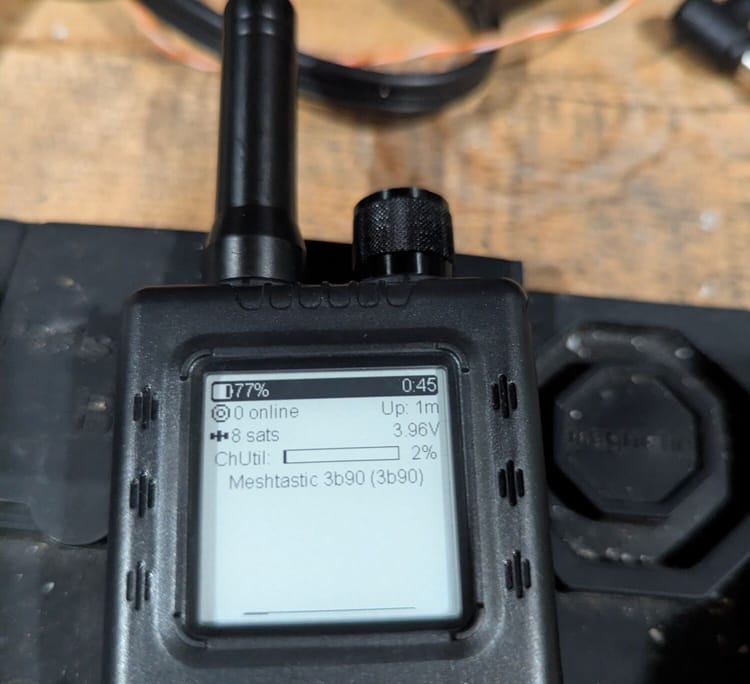
Handheld nodes, a T-Beam with an 18650, a T-Echo, anything battery-operated, are by definition grid-independent. Charged before the event, they're ready. Discharged because you forgot, they're not. Keeping a handheld node maintained is a habit, not a one-time act.
What to Do Before the Emergency
This is the section that matters most. None of the following is complicated. All of it has to happen before you need it.
Get a node on the mesh now. A $25 Heltec V3 flashed with Meshtastic and connected to the NEPAMesh network is sufficient. You don't need the most expensive hardware. You need a working node that you've actually tested.
Know how to use the app. Open it. Send a test message. Confirm your node shows up on map.nepamesh.com. Find out whether you can reach other nodes from your home. If coverage at your location is weak, that's information you want now, not when you're standing in a dark house after a storm wondering why nobody's responding.
Set up a family or household channel. Meshtastic supports secondary channels with custom encryption keys, separate from the public mesh channel. Create one for your household. Share the key with whoever needs it. That channel is your private family check-in line during an event, messages on it don't go to the whole mesh, just the people who have the key.
Know your mesh neighbors. Look at the map and identify which nodes in your area are solar-powered or otherwise likely to stay up during a power outage. The NEPAMesh Discord is a good place to ask which nodes in a specific area have reliable power. Knowing that the node on the ridge two miles away is solar and will be up regardless of grid status tells you something about what communication will look like if the power goes out.
Keep your mobile node charged. A handheld node at 0% battery is not a communication tool. A power bank that's been sitting in a closet for six months may also be significantly discharged. Charge these things periodically. The habit costs almost nothing and it's the difference between useful and useless when something happens.
Have a plan that doesn't depend on the mesh. Know where you'd go if you needed to leave your home. Know how you'd reach family members if no communication technology was working at all. Meshtastic is a layer on top of a plan, not the plan itself. A radio that's down for any reason, dead battery, coverage gap, node offline, can't substitute for knowing where your family's meeting point is.
ARES and Amateur Radio
The Amateur Radio Emergency Service (ARES) operates in Northeastern Pennsylvania and coordinates with county emergency management. Licensed ham operators have been providing emergency communication support during disasters here for decades, they were active during Agnes, during Lee, and during other significant events.
Meshtastic doesn't require a license and isn't affiliated with the amateur radio emergency communication infrastructure. But the goals overlap significantly, and the communities are compatible. Several NEPAMesh participants are also licensed hams. If you're interested in emergency communication seriously enough to pursue a license, ARES is the organized structure that puts trained operators into the field when things go wrong. The ARRL ARES page has contact information for local sections.
For NEPAMesh specifically: we're a community mesh network, not an official emergency communication system. We don't have formal relationships with county emergency management. What we have is a growing network of nodes across the region that will keep working when other systems don't. That's genuinely useful even without the formal structure.
The Straightforward Case
The argument for having a Meshtastic node during an emergency isn't complicated. It's a $25 radio. It doesn't cost money to run. It works without cell towers, without internet, without grid power. The NEPAMesh network already covers significant portions of Luzerne, Lackawanna, and the surrounding counties, with nodes on ridgelines that run on solar and stay up regardless of what the grid is doing.
NEPA loses cell service and grid power during serious weather. NEPA has serious weather. A working node on the mesh, tested, charged, configured, is a communication option that exists when others don't.
The only way it doesn't work for you during an emergency is if you haven't set it up and tested it before one happens. That part is entirely within your control, and it's available right now.
The NEPAMesh Discord is the right place to ask questions about getting set up, finding out what coverage looks like in your area, or connecting with others thinking about the same things. We're at discord.gg/cSpfk6H2hz.
Meshtastic is a registered trademark of Meshtastic LLC. No warranty is provided, use at your own risk. This post is not endorsed by or affiliated with Meshtastic LLC.