UPDATE: NEPAMesh Games: MeshTrader, Red Dragon, and Pathfinders Over the Mesh
UPDATE: Due to lack of interest this has been discontinued. The github is still active if you wish to put up your own, however the service has been retired and hardware repurposed. It may return in the future when additional hardware is acquired.
If you have a Meshtastic node and you can reach the NEPAMesh network, you can now play games on it. DM the node called Path and the mesh sends you a menu. No app, no account, no login — your node ID is your player identity and the game state lives in a database that persists across restarts. It is a BBS, in the tradition of dial-up door games, running over LoRa radio in northeastern Pennsylvania in 2026.
Three games are available: MeshTrader, Legend of the Red Dragon, and Pathfinders. The first two are door game classics. The third one is new, and it is the one that actually matters for the network.
How to Connect
Send a private DM — not a channel message, a direct message — to the node named Path (Pathfinder(NEPAMesh.com)). You will get back a menu:
=== NEPAMesh BBS ===
1) MeshTrader
2) Red Dragon
3) Pathfinders
Reply 1-3 | quit to exit
Reply with a number to start a game. Reply quit or menu at any time to go back to the menu. Your progress in each game is saved between sessions. If you put the phone down and come back tomorrow, your MeshTrader inventory and cash are still there.
One note on Meshtastic message limits: every response is 200 characters or less, sometimes split across multiple packets labeled (1/2), (2/2). Plain text only — no color, no graphics. It fits the format.
MeshTrader
Buy and sell Meshtastic hardware across six regional venues. The same core mechanics as the original door game Drug Wars — 30 days, fluctuating prices by location, buy low and sell high — rebuilt around the gear that's actually on this network.
You start with $2,000 cash and $5,500 in vendor credit debt. Six venues: Scranton, Wilkes-Barre, Allentown, Philly, Pittsburgh, and the NYC Hamfest. Six items: SMA connector packs, Heltec V3 modules, T-Beams, RAK4631 dev kits, WisGate gateways, and T1000-E tracker lots. Prices vary by venue and reset daily. The market uses a deterministic seed — every player on the mesh sees the same prices at the same venue on the same day. Shared market, level field.
Commands: status, buy [item] [qty], sell [item] [qty], jet [N], bank deposit [amt], bank withdraw [amt], borrow [amt], pay [amt]
D5/30 Scranton $1,200 HP:100
T1:$22k GW:$8.5k Rk:$2.1k
Tb:$540 He:$130 Sm:$28
Inv:Tb:3 He:10
Debt:$5,500 Bank:$0
buy/sell ITEM QTY|jet N|bank|borrow|pay|quit
Random events: a customs delay that confiscates part of a shipment in transit, or a swap table deal that drops free gear into your inventory. Net worth at day 30 — cash plus bank minus debt — is your final score. The arbitrage is the same for everyone; it comes down to who reads the market and moves first.
Legend of the Red Dragon
A shared-world RPG. Every player who DMs the node is in the same game world.
You set a name on first play. Then you fight monsters to earn experience and gold, level up through ten levels, heal at the tavern, and — if you're feeling aggressive — challenge other players to PvP combat. Daily fight limits reset at midnight UTC. If someone attacks you while you're offline, you get the result as a notification the next time you log in.
[Red Dragon] Lv2 HP:85/100
Gold:250 EXP:180/300 Fights:8
F)ight A)ttack T)avern S)tatus
Monsters scale with level. Slimes at level one. Wolves, trolls, and eventually dragons as you climb. The tavern shows other active players and lets you heal. PvP is always on — you can be attacked by anyone on the mesh, so keep your HP up.
Commands: fight, attack [player name], tavern, status, name [new name]
Pathfinders: The Game That Actually Builds the Network
MeshTrader and Red Dragon are the classics. Pathfinders is something different — it's the reason this whole project exists.
Here's the problem Pathfinders is solving: NEPA's ridge-and-valley terrain creates massive dead zones in the mesh. The Wyoming Valley is walled in by 500–800 feet of ridge on multiple sides. The Lackawanna corridor has the same issue. Nodes on valley floors connect to their neighbors and not much else. The network has gaps, and those gaps don't fill themselves.
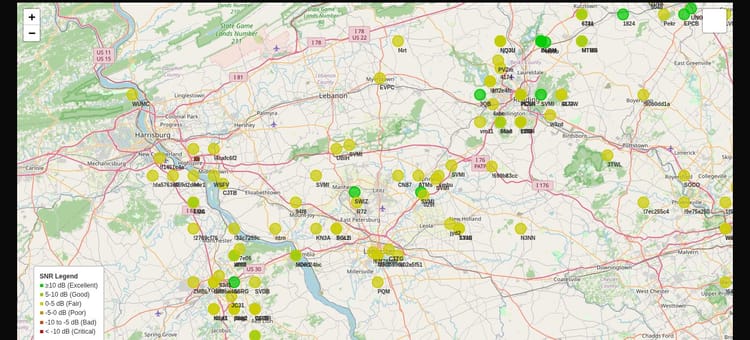
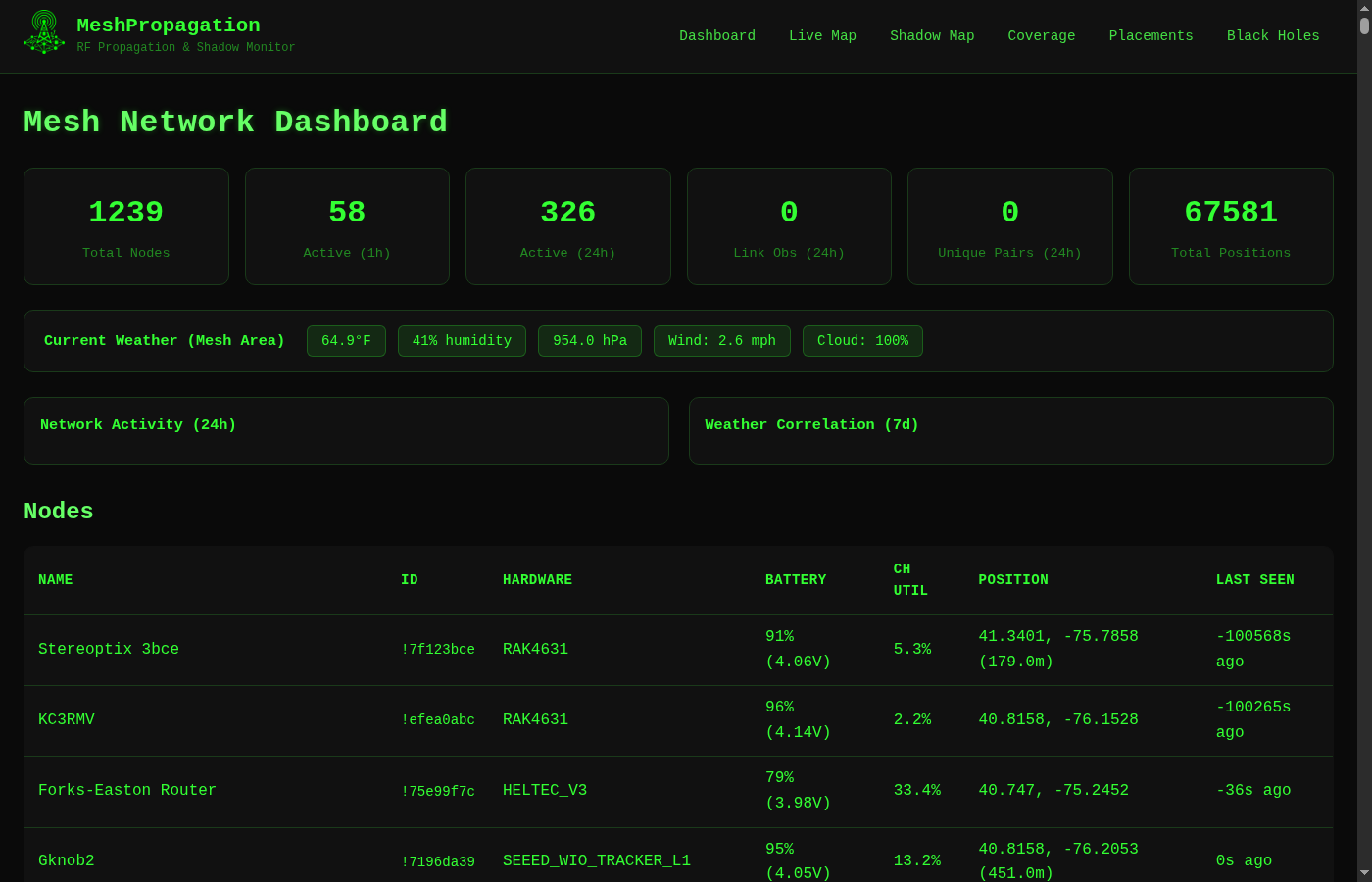
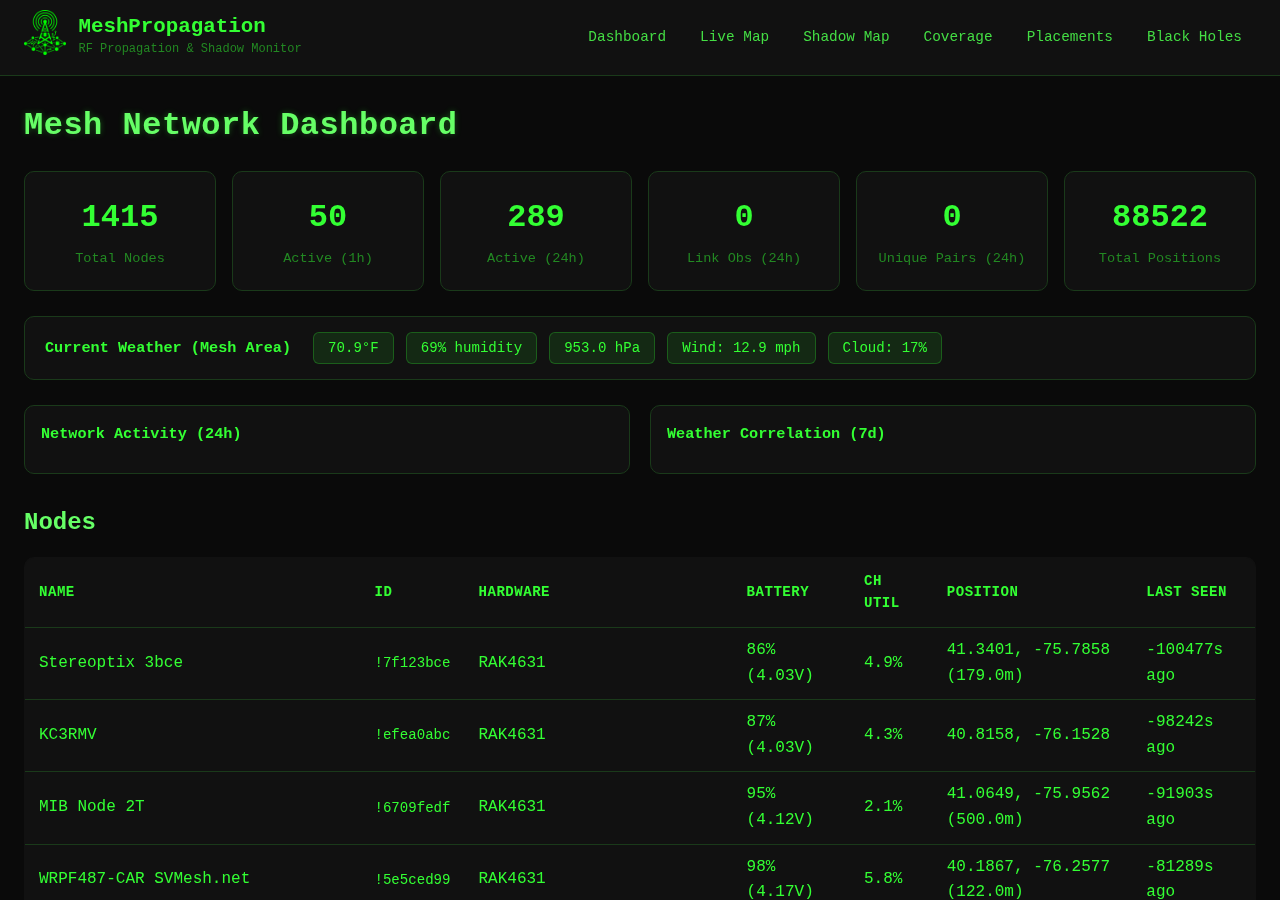
propagation.nepamesh.com shows you exactly where the dead zones are. The Shadow Map is a live terrain analysis of the entire NEPAMesh network — red zones are areas the current node deployment cannot reach, updated every ten minutes as nodes come online and go offline.
Pathfinders turns filling those gaps into a competition. The rules are simple:
- Find a shadow zone on the map.
- Deploy a Meshtastic node there — on a ridge, on a rooftop, on a tower, wherever you can get elevation and line of sight into the dead zone.
- Once it comes online and the network sees it, DM
claim [short name]to the BBS. - The BBS verifies the node, evaluates its coverage impact against the real terrain model, and awards points.
100 points per 1% of shadow area eliminated.
This isn't an arbitrary score. When you claim a node, the BBS calls the MeshShadow propagation API with that node's exact GPS coordinates. MeshShadow runs the same line-of-sight terrain model it uses for the Shadow Map — SRTM elevation data, per-cell coverage calculation across the entire grid — and measures how much of the currently-shadowed area that new position covers. That percentage reduction is your score. A well-placed node on a ridge overlooking a dead valley can score 2,000–3,000 points in one claim. A node sitting next to three others scores zero. The terrain doesn't lie.
claim Alpha
> Checking Alpha... Coverage +22.4%
> Claimed! +2240 pts (total: 4890)
That's not a made-up number. That's 22.4% of the mesh shadow area that no longer exists because someone put a node in the right place.
The Strategy
The shadow map is the strategy guide. Everything else follows from that.
- Location beats hardware. A $20 Heltec V3 zip-tied to a mast at 1,400 feet on a ridge crest will outscore a $150 RAK in a basement in the Wyoming Valley. Every time. Elevation and line of sight are the only variables that matter for scoring.
- Ridge crests are where the points are. The Moosic Mountain ridge, Elk Mountain, Spring Mountain, North Mountain — these are the high-value targets. A single node on a bare ridge with good sky view can cover dozens of square kilometers of shadow in one claim.
- The Placements page does the math before you commit. Before you drive anywhere, open propagation.nepamesh.com and use the Placements evaluator. Enter a set of coordinates and it tells you exactly how much shadow that location would eliminate. You'll know your score before you set foot outside.
- Duplicating existing coverage scores zero. Don't claim a node sitting next to three others on the valley floor. The shadow map will show you whether a site actually matters.
Not sure where to start? Use the hints command from inside Pathfinders. It returns the top three recommended placement locations from the MeshShadow placement engine — actual coordinates of grid cells that, if covered, would eliminate the most shadow area right now.
The Rules
- Nodes that existed before Pathfinders launched are in a protected baseline and cannot be claimed. The game is about new coverage, not retroactive credit for existing nodes.
- A node without a GPS position cannot be scored — the terrain model needs coordinates to work. Make sure your node is reporting its location before you claim it.
- First claim wins. Once a node is claimed, it's off the board.
- The
claimcommand works from any game — you don't need to be in the Pathfinders menu. If you're mid-game in MeshTrader and your node just came online,claim [short name]works right there.
Other Pathfinders commands: scores (top five), mystats (your nodes and total points), coverage (current mesh coverage percentage), hints (top three placement recommendations).
The Leaderboard
Pathfinders scores hit the public leaderboard at leader.nepamesh.com within five minutes. MeshTrader and Red Dragon have their own pages — leader.nepamesh.com/meshtrade ranks traders by final net worth, and leader.nepamesh.com/redragon ranks warriors by level and experience.
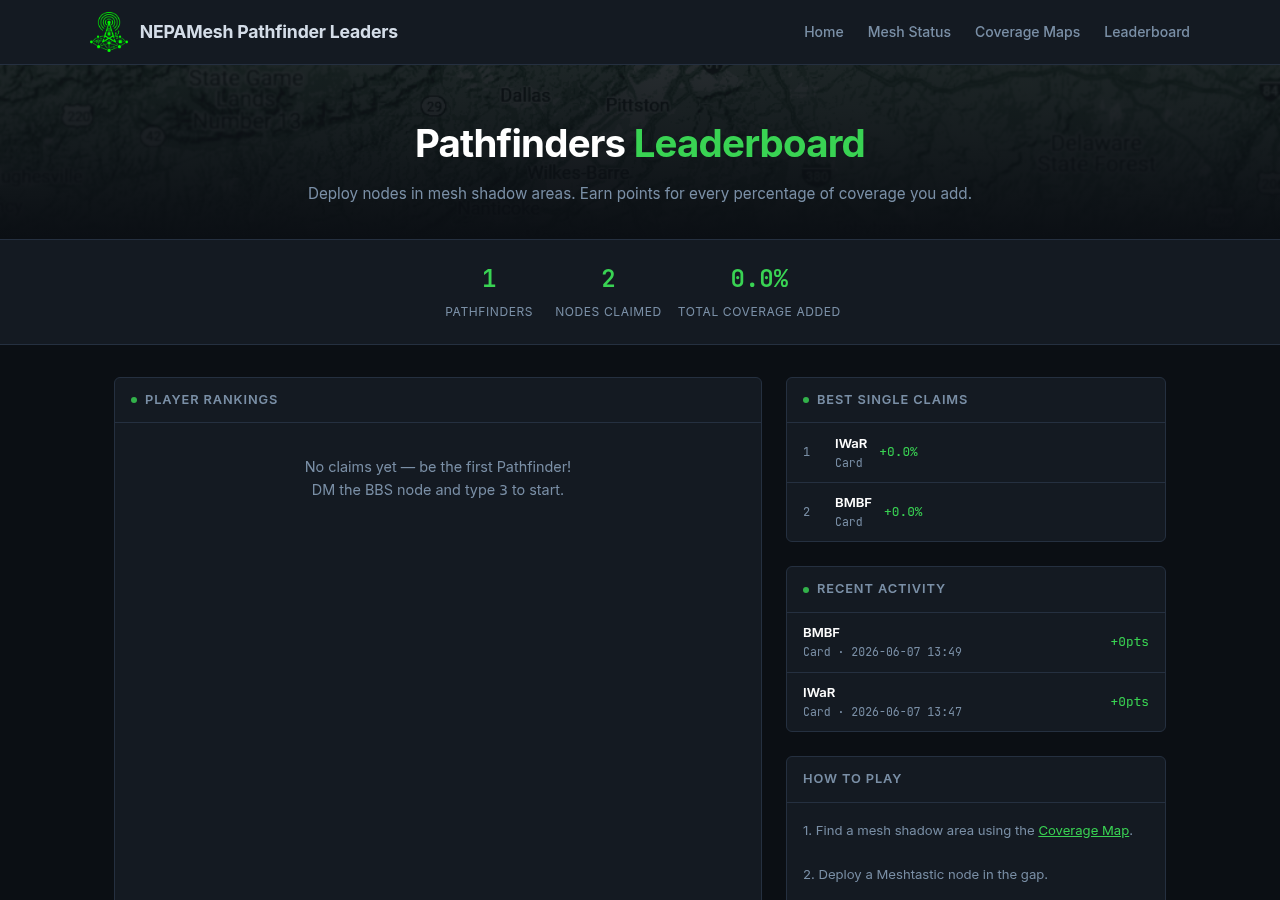
The leaderboard shows Pathfinder rankings by total points, the best individual claims by coverage percentage, and a real-time feed of recent claims. No account, no login — it's a public page. The database syncs from the BBS node to the leaderboard server every five minutes over SSH; the leaderboard serves rankings from there.
The top of the Pathfinders leaderboard isn't going to be whoever has the most nodes. It's going to be whoever has the best-placed nodes. One claim on Elk Mountain ridge is worth more than twenty nodes on the valley floor. That's intentional.
Getting Started
- Find the node. In the Meshtastic app, look for Path in your node list, or
Pathfinder(NEPAMesh.com). If you can hear it, you can DM it. - Send a DM. Not a channel message — a direct message, the same as you'd send to another person on the mesh.
- Pick a game. Reply
3for Pathfinders.1for MeshTrader,2for Red Dragon. - For Pathfinders: open the Shadow Map first. Find a red zone. Get a node up there. Then
claimit.
Open Source
The full source for the BBS and leaderboard is published at github.com/nepamesh/Leader-BBS.
If you're running a Meshtastic network somewhere else and want to run your own instance — the BBS, the Pathfinders game, the leaderboard — it's all there. Docker Compose for both containers, instructions for the SSH sync between BBS and leaderboard server, and the MeshShadow integration. The only hard dependency for Pathfinders scoring is a running MeshShadow instance pointed at your network; everything else is self-contained.
The mesh gets more useful every time someone adds a well-placed node. Pathfinders is a way to see who's doing the most to fill in the gaps — and to make a game out of the part of mesh building that actually matters: getting hardware somewhere the network actually needs it.
Shadow map: propagation.nepamesh.com
Leaderboard: leader.nepamesh.com
Source: github.com/nepamesh/Leader-BBS